

 English
 Français
 русский
 عربى
 Español

A foldable play mat is one of those quiet purchases that ends up shaping a family's daily routine. It becomes the spot where a baby first pushes up on hands and knees, where a toddler builds the same tower forty times, and where a picnic lunch happens on a damp Saturday in spring. We make the printed film and laminated foam layers that sit inside many of these mats, so we have seen up close what separates a mat that survives three years of daily use from one that creases and peels within a season.
This guide walks through the construction, the trade-offs, and the small details worth checking before you buy, whether you are outfitting a nursery, a holiday home, or a shipment bound for a retail chain.
Content
- 1 What a Foldable Play Mat Really Is
- 2 Materials That Decide How a Mat Feels and Ages
- 3 How Thickness Affects Comfort and Safety
- 4 Comparing Common Foldable Mat Constructions
- 5 Indoor Play, Outdoor Picnic, and Everything Between
- 6 A Simple Checklist Before You Buy
- 7 Working With a Manufacturer Who Prints and Laminates In-House
- 8 Keeping a Foldable Mat in Good Shape
What a Foldable Play Mat Really Is
Most foldable mats follow the same basic idea: several panels of foam, each wrapped or laminated with a surface layer, joined along hinge lines so the whole thing collapses into a compact block. Panels are commonly between 30 and 60 cm wide, and a four- to six-panel mat opens into something roughly 150 by 200 cm. Folded, it slips behind a sofa or into a car boot.
The appeal is speed. A rolled mat needs to be unrolled and weighted down before it lies flat; a folded mat is ready in seconds because the hinge creases hold the panels flat. The trade-off is that those same hinge lines are the first place to show wear. A well-made mat uses a continuous surface film across the joints or a reinforced hinge strip, so the pattern does not crack along the fold after a few hundred open-and-close cycles.
Materials That Decide How a Mat Feels and Ages
The foam core
Cross-linked polyethylene, usually shortened to XPE, is the standard for mats meant for daily family use. It is closed-cell, so it resists water and does not sponge up spills, and it recovers its shape after being compressed by knees and furniture legs. EPE is the lighter, softer relative: cheaper, springier, and fine for occasional use, but it takes a permanent set faster under constant load. Thickness for either typically runs from about 0.5 cm to 1.5 cm.
The printed surface film
This is the layer people actually see and touch, and it does most of the work in a mat's appearance and cleanability. A pattern is printed onto polyethylene film on multi-colour presses, then bonded to the foam by extruded, solvent-free, or dry lamination. Print width matters here: our own six-colour presses run up to 2400 mm, which allows a full mat width to be printed in one pass rather than pieced together. A matte finish hides scratches and reads as fabric; a gloss finish wipes clean more easily but shows scuffs. A properly laminated film will not delaminate when wiped with a damp cloth, which is the failure mode to watch for in bargain mats.
Backing and edges
The underside determines whether the mat stays where you put it. A fine embossed texture grips wooden floors and tiles far better than a smooth surface. Edges should be sealed or bound rather than left as exposed foam, since open edges fray, collect crumbs, and let moisture into the core.
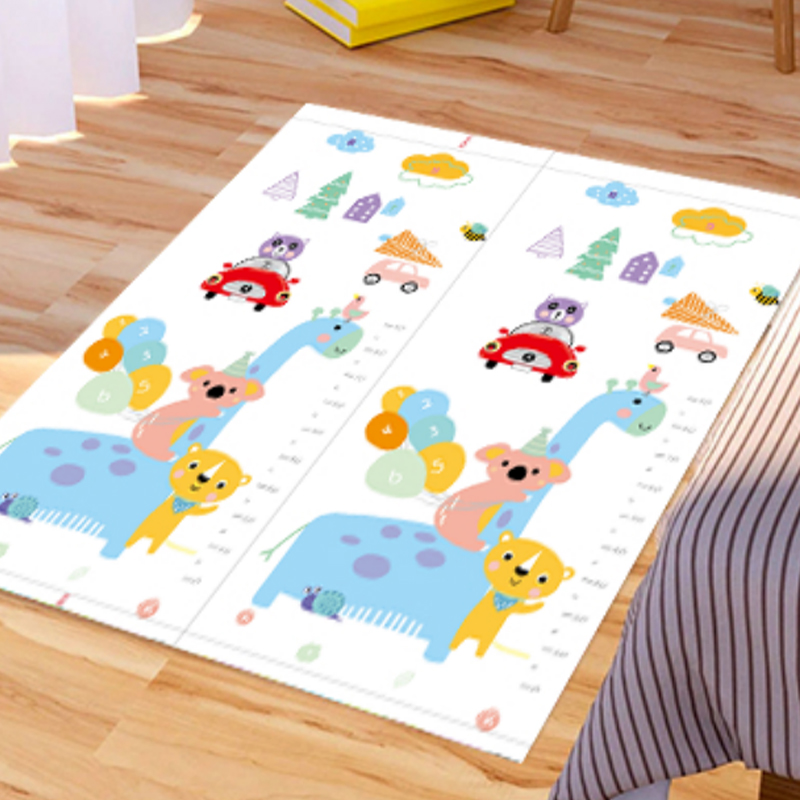
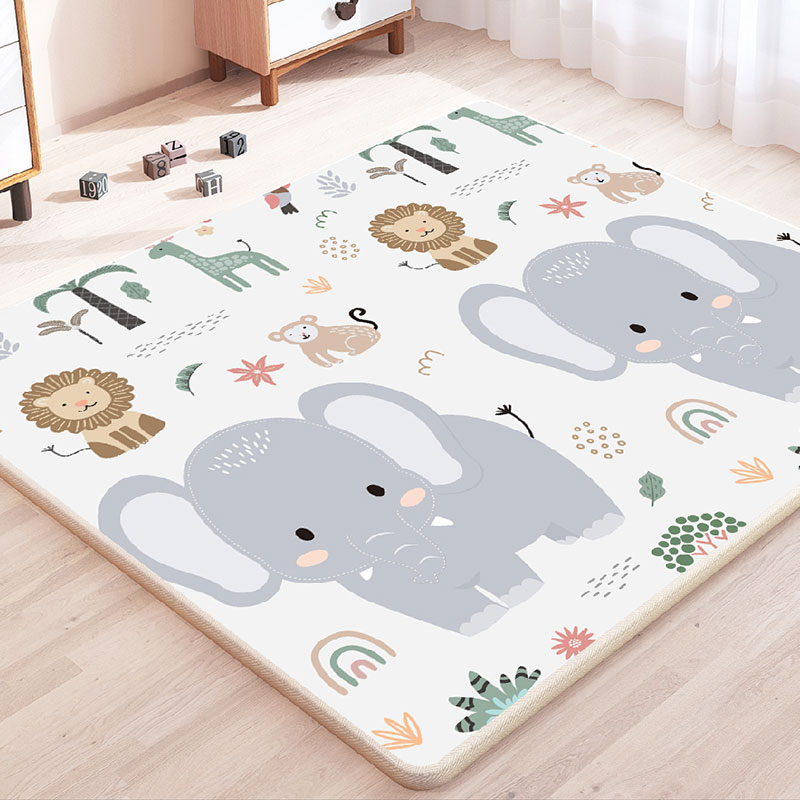 XPE Foldable Home Floor Mat with Matte FilmA foldable XPE home mat with matte printed film, designed to fold quickly and save space; useful when comparing practical floor mats for home.View Product →
How Thickness Affects Comfort and Safety
Parents tend to assume thicker is safer. In practice, firmness matters at least as much as the number on the label. A soft 1.5 cm mat can bottom out under a kneeling adult, while a dense 1 cm mat distributes weight and cushions a backward tumble more reliably. For a baby who is sitting and crawling, a mat in the 1 cm to 1.2 cm range with a dense core is usually the sweet spot. For toddlers who are steady on their feet, a thinner, firmer mat is more stable and less likely to trip them at a fold line.
If you want the detail behind that rule of thumb, we wrote a longer piece on how the thickness of a foldable crawling mat affects comfort and safety, including what happens to impact absorption as foam density changes.
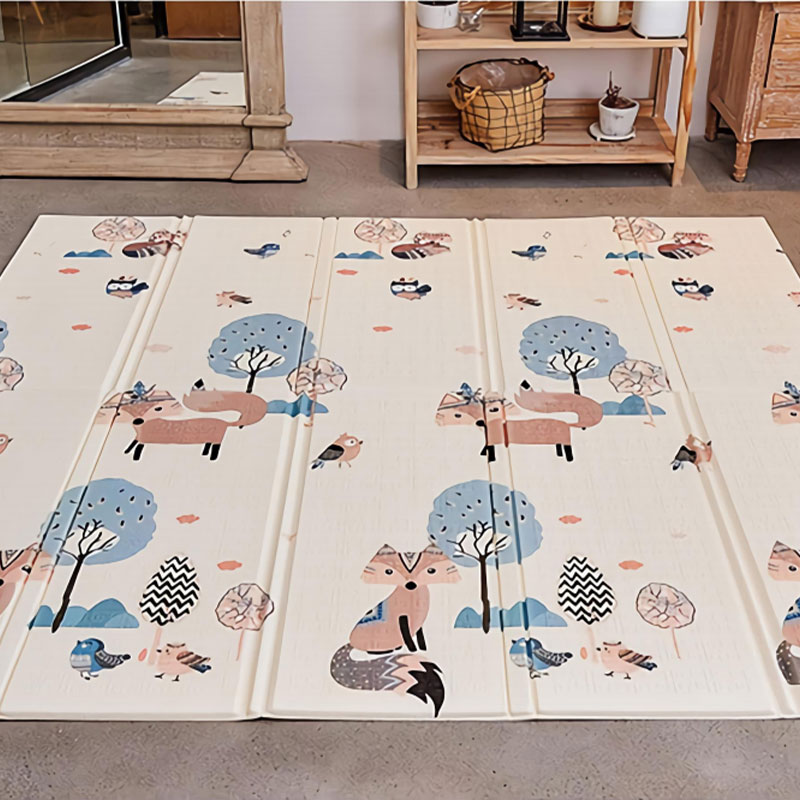 Thickened Foldable Baby Crawling Mat with Printed PatternsA foldable baby crawling mat in 0.5–2 cm thickness with non-slip, easy-clean surface and printed patterns; useful when comparing thickness options.View Product →
Comparing Common Foldable Mat Constructions
The table below is a rough comparison of the builds we encounter most often. Exact numbers vary by supplier, foam density, and thickness, so treat it as a starting point rather than a specification.
| Construction | Surface feel | Cushioning | Cleaning | Typical use |
|---|---|---|---|---|
| Printed film on XPE foam | Firm, smooth or embossed | High, holds shape | Wipe with damp cloth | Daily nursery and playroom use |
| Printed film on EPE foam | Softer, lightweight | Medium, compresses over time | Wipe with damp cloth | Occasional use, travel, guest rooms |
| Fabric-topped foam | Warm, textile hand feel | Medium to high | Spot clean, slower drying | Living areas where appearance matters |
| Double-sided printed film | Reversible, two patterns | Depends on core | Wipe with damp cloth | Rooms that change with the season |
| Moisture-barrier picnic build | Wipe-clean, compact fold | Low to medium | Rinse and air dry | Outdoor meals, camping, travel |
Indoor Play, Outdoor Picnic, and Everything Between
The same folding principle covers two quite different jobs. An indoor mat lives on a floor for years and needs cushioning, grip, and a surface that survives juice, paint, and a hundred wipe-downs. An outdoor mat spends most of its life folded in a cupboard and then has to block ground damp, resist grass stains, and shake clean in under a minute.
If you plan to use one mat for both, look at the backing first. A fine embossed texture works on timber and tile but can slide on smooth decking, while a slightly tackier underside grips both. Weight is the second consideration: a large XPE mat is comfortable indoors but heavy to carry, whereas a thinner moisture-barrier build folds smaller and suits a car boot. For families who camp or travel often, a dedicated outdoor mat is usually the more practical answer.
 Foldable Outdoor Picnic and Beach MatA foldable moisture-proof picnic mat for grass, beach, camping, and indoor play, with PE film, PE cotton, and VMPET backing.View Product →
A Simple Checklist Before You Buy
- Measure the floor area you want covered, then check the mat's open dimensions rather than the panel count.
- Check the folded size against where it will actually live: behind a door, under a bed, in a car boot.
- Confirm the foam type and density, not just the thickness figure.
- Test the surface by wiping a corner with a damp cloth; a good film stays crisp and does not lift at the edge.
- Run a finger along the fold lines and seams to check for exposed foam or loose binding.
- Unfold a new mat and let it air for a day or two; a mild, fading smell is normal, a sharp persistent one is not.
- Ask for a material specification sheet if you are buying in quantity for a nursery, retail chain, or rental property.
Working With a Manufacturer Who Prints and Laminates In-House
We are a production company, not a retailer, and that shapes how we think about these products. Our factory in Guangde, Anhui handles the full chain: printing the pattern, laminating it to the foam, slitting to width, and checking the finished roll or panel. Because the film and the foam bond under our own roof, we can adjust texture, matte level, and pattern registration without sending anything out. It also means we can talk honestly about what a given construction will and will not survive after two winters in a holiday cottage.
Most of our work is for importers, distributors, and brand owners who need consistent runs and their own artwork. Mats ship across Europe, the Americas, and Southeast Asia, alongside our wall films and industrial laminates. If you are still weighing up patterns, panel counts, and safety details, our note on picking the safest and most practical foldable play mat covers the questions buyers ask us most often, and you can browse the current crawling mat range to see how the constructions differ in practice.
Keeping a Foldable Mat in Good Shape
Care is simple and mostly about habit. Wipe spills promptly with a damp cloth and a mild soap rather than a solvent cleaner, which can dull a printed film. Keep the mat out of prolonged direct sun, since UV exposure yellows foam and fades ink faster than any amount of play. Store it folded flat rather than propped on a corner, so the hinge lines are not permanently bent. Once a month, unfold it fully and let it breathe for a few hours.
None of this is complicated. A mat built with a dense core and a properly bonded printed film, kept reasonably dry and out of the sun, will usually outlast the stage of childhood it was bought for, and often the next one after that.